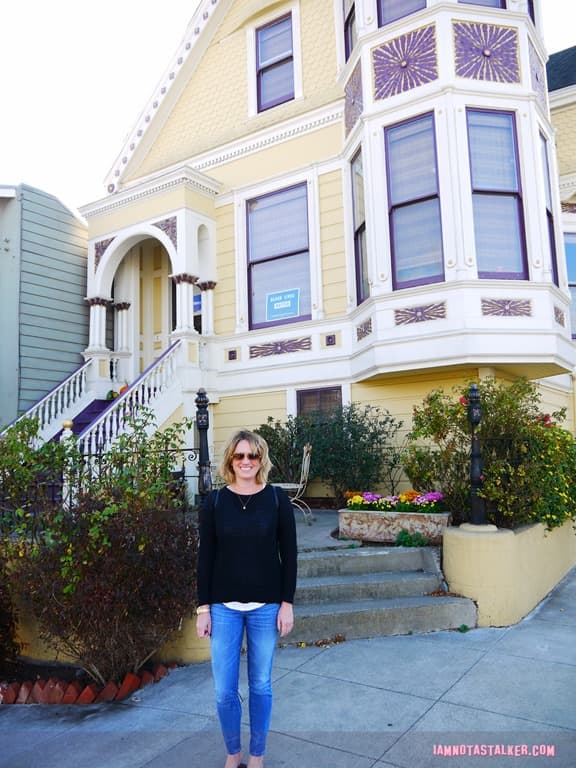
Calling all Princess Diaries fans! The private residence that played Grove High School in the beloved 2001 movie is for sale. You can read about it in my latest post for Dirt.

Your definitive source to filming locations and all things Hollywood!

Calling all Princess Diaries fans! The private residence that played Grove High School in the beloved 2001 movie is for sale. You can read about it in my latest post for Dirt.

If you watched the Apple TV+ series Surface, you no doubt became enamored with the main house featured in it. You can read all about the residence in my latest post for Dirt.
Calling all fans of The Matrix! The townhouse that played the home and office of The Analyst (Neil Patrick Harris) in the franchise’s fourth installment, The Matrix Resurrections, just hit the market! You can read about it over on Dirt.
Don’t forget to check out my latest Haunted Hollywood post on Dirt.com. It’s about the Nob Hill house from Season 2 of The OA.
Pre-COVID and before my dad’s many complications following his February surgery, I was planning a surprise trip for the Grim Cheaper’s March birthday. Even though it involved a flight, I was over-the-moon excited about it. Our travels obviously had to be postponed and, considering the current climate, who knows when we will be able to embark upon the short getaway. In light of my and so many others’ vacation delays, I figured a virtual trip was in order! So I enlisted my BFF Nat, who lives in the Bay Area, to do some stalking on my behalf. Though I consider all locations immensely important to a production (duh!), the residence I sent her to stalk is the centerpiece of The Last Black Man in San Francisco. Without the spectacular house at the heart of the feature, there is no story. So, obviously, one look at the trailer, and I was all in! The 2019 drama tells the tale of Jimmie Fails (played by the actor of the same name), an SF native obsessed with restoring his childhood home, a towering Victorian that his grandfather built by hand in 1946. The only problem? His family no longer owns the place. But that doesn’t stop him from painting the eaves, weeding the yard, and, in a bold move, secretly moving in. The movie couldn’t be more up my alley if it tried! Before watching even a single frame, I did some research on the property that figures so prominently in it and sent Nat right out to stalk it.
[ad]
Known as the John Coop House in real life, the stunning Queen Anne Victorian was designed by German-born architect Henry Geilfuss for mill owner John Coop in 1889. Coop did much of the carpentry himself and, upon its completion, utilized the ornate residence as a showpiece of his work.
Said to be at 959 Golden Gate Avenue in San Francisco’s Fillmore District in the movie, the home actually stands at 959 South Van Ness Avenue in the Mission.
The massive property, easily the grande dame of the neighborhood, boasts 6 bedrooms, 3 baths, a whopping 5,240 square feet, a carved staircase, wainscoting throughout, a wood-paneled library (with a secret chamber concealed behind a bookshelf!), a formal parlor, ceiling frescoes and friezes, stained glass windows, a tiled fireplace, a turret capped by a “witch’s hat,” and a 0.10-acre lot (which is actually pretty spacious for San Francisco).
Though the house is striking both onscreen and off, The Last Black Man in San Francisco, sadly, left me wanting. On paper, the narrative (loosely based upon Jimmie Fails’ real life) couldn’t be more compelling, but it moved slowly (almost painfully at times), bounced around in too many directions, and as a whole felt lacking. That’s not to say there aren’t good points. I fell in love with the main characters, Jimmie and his BFF, Montgomery Allen (Jonathan Majors) – serious #friendshipgoals there! Cinematically, it is one of the most beautiful films I’ve ever seen and, having grown up in the Bay Area, I can say paints a very accurate portrait of life in the city (especially that bus stop scene!). And hey, I’m willing to forgive all being that the house is not just a character in it, but the character! Location manager Daniel Lee certainly had his work cut out for him in finding the ideal residence to ground the movie – a painstaking process that, per Curbed, took several years. It was worth the elbow grease, though, because Lee hit the nail on the head with the John Coop House! I don’t know how one could look at the image below, with the pad showcased in widescreen glory, and not be smitten! Of scouting for the location, director Joe Talbot said, “We wanted to find a place that would hopefully make the audience feel those things Jimmie is feeling. It sounds silly to say this, but we needed the house to feel like a character, to feel developed, to go through its own arc.” Talbot obviously doesn’t read my blog – if he did, he’d know that’s not a silly sentiment at all!
Interestingly, in the first two shots we get of the dwelling, there are discrepancies. Though the images are shown within minutes of each other and are supposed to represent the same day, some changes occur from one to the next. As you can see in the first shot (the top screen capture below), the residence to the direct left of the John Coop House has a light green roof and the pad two doors to the right is painted yellow. In the second shot, though (lower cap below), the property to the left has a dark green roof and the one two doors down is now black. Talbot did express to Curbed that the rapidly shifting nature of the city posed some problems for the shoot. The article states, “Changes to approved and permitted filming locations happened so quickly—sometimes from one day to the next—that they created continuity challenges and compromised the film’s cinematography.” I am guessing this is one of those instances. I’m shocked it wasn’t noticed – and corrected – in post-production, though.
The odd triangle-topped garage door ornamentation, which was (thankfully) covered in foliage for much of the shoot and only unveiled at the end of the movie after Jimmie’s childhood home has supposedly been renovated, is unsightly, to say the least. Per the San Francisco Daily Photo blog, the Coop House originally boasted a single garage that was enlarged (to its aesthetic detriment) in 1998. You can see a photo of it prior to the augmentation here.
The film certainly showcases the rest of the Coop House in spectacular fashion.
And the interior is even more magical than the exterior!
It is so ornate and enchanting, in fact, that I thought it could only be the stuff of a production designer’s imagination – a production designer with a hefty budget, no less. I was thrilled to discover that was not the case. Incredibly, the ornate detailing captured so beautifully onscreen is authentic to the residence! As stated in Curbed, “Everything you see in the film—the hardwood floors and the intricate period molding, yes, but also the secret room behind a bookshelf, the built-in organ, the attic big enough to host the play-within-the-film, even the sauna—is actually in that damn house.” An architectural survey of the property conducted in 1975 sums the place up perfectly, noting it “has one of the most outrageous interiors – ornament is heaped upon ornament.” You can check out some fabulous photos of the inside of the Coop House here.
In a case of art imitating life, for decades the pad has been owned by a man whose life has been shaped by it. Retired chemist Jim Tyler was first introduced to the Victorian in the early 1960s when he attended a party there. Wholly transfixed, he acquired the place just a short time after, trading his own house for the then-stark property, which did not even have heating at the time. He was forced to sell it within two short years and moved away from San Francisco, but, like Jimmie, the home always remained close to his heart. When Tyler returned to the city in 1970, the house happened to be for sale and he liquidated all he had to re-purchase it. A man after my own heart, he has spent the last five decades assiduously restoring and enhancing it, as well as researching and documenting its history. The John Coop House is certainly the love of Tyler’s life, as it was onscreen in Jimmie’s – and his adoration for it shows clear as day to anyone who passes by.
Big THANK YOU to my friend Nat for stalking this location for me! ![]()
For more stalking fun, follow me on Facebook, Twitter, and Instagram.
Until next time, Happy Stalking! ![]()
Stalk It: The John Coop House, aka Jimmie’s childhood home from The Last Black Man in San Francisco, is located at 959 South Van Ness Avenue in the Mission District.
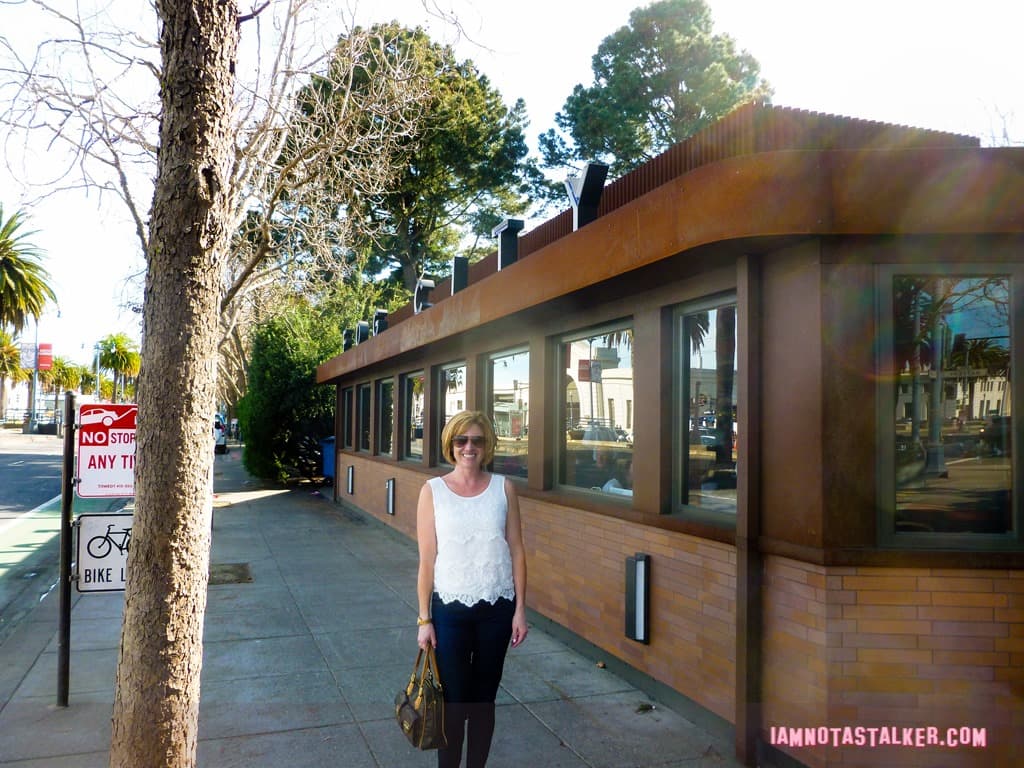
I abhor change, as longtime readers of this site well know. So I was devastated to learn that Fog City Diner, the landmark eatery in my hometown of San Francisco, had undergone a major revamp and reopened as the simpler, sleeker and far more modern “Fog City.” The shiny chrome train-like structure situated on Battery Street at The Embarcadero had been a staple of the city’s skyline for decades and a harkening back to my childhood every time I passed by. I was informed of the unseemly renovation while visiting my friend Nat, who lives in the area, in February 2015. Despite my sadness over the matter, since the restaurant’s former iteration made an appearance in the the 1993 comedy So I Married an Axe Murderer, we decided to head over there for some brunch/stalking my last day in town.
[ad]
Fog City Diner was originally established in June 1985 by restaurateurs Bill Higgins, Bill Upson and Cindy Pawlcyn, of Napa’s Mustards Grill fame. Designed by Pat Kuleto, the unique space bore the look and feel of a streamlined 1930s diner, but a very high class one, with the reimagined comfort food offerings to match. Just steps from the waterfront, the site where the eye-catching eatery was erected was originally home to a train engine repair facility. It became a coffee shop named Harbor Cafeteria, which catered to soldiers and sailors, in 1958. After going through several different restaurant incarnations, including Mildred Pierce and Battery Point, in the years that followed, it was eventually transformed into the gleaming chrome fixture that instantly became a San Francisco icon. You can check out some images of what it looked like here and here.
Sadly, in 2013 Higgins and Upson (Pawlcyn had long since dropped out) decided to give the restaurant a complete overhaul. It shuttered in March of that year and then re-opened six months later as Fog City. During the renovation, the historic and well-loved site was taken down to its studs and then rebuilt by architect Michael Guthrie. The new design, which sort of retains its diner shape, boasts a large central bar, seating for 160 patrons, an exhibition kitchen with a wood-fired oven and seven-foot grill, and views of the San Francisco Bay. Though pretty, all of the elements that made the place so unique have disappeared. Gone are the dark leather train-car-like booths, checkered tilework, handsome wood detailing, and fabulous chrome siding.
The revamped site looks like a normal, everyday restaurant, both inside and out.
When I visited Fog City for the first time as a kid, I remember being absolutely mesmerized. I truly felt as if I had entered an antique train car and was dining atop the rails. It was a magical experience – one that did not wane, even as I continued to frequent the eatery as a teen and adult. Sadly, the redesign just does not compare to the Fog City of old. You can check out what the interior formerly looked like here and here.
Thankfully, I can at least report that the food is still as good as ever.
In So I Married an Axe Murderer, Charlie Mackenzie (Mike Myers) takes Harriet Michaels (Nancy Travis) on a rather awkward double date with his friends Tony Giardino (Anthony LaPaglia) and Susan (Debi Mazar) at Fog City Diner.
The film gives audiences a fabulous glimpse of what the exterior . . .
. . . and interior of the restaurant looked like pre-remodel.
As you can see in the screen capture as compared to the photograph below, though the footprint of the structure remains the same, its aesthetic is a far cry from what it used to be.
Fog City Diner was the also site of a famous Visa commercial from 1990 (well, it was at least famous to us San Franciscans), which you can watch here.
And it was satirized as the Fog City Dumpster, a restaurant run by a group of bears, in Farley, the popular San Francisco Chronicle comic strip that ran from 1975 to 2007.
Fog City Diner was supposedly featured in an episode of Nash Bridges, as well, but I am unsure of which episode. If anyone happens to know, please fill me in!
For more stalking fun, follow me on Facebook, Twitter, Instagram, Los Angeles magazine and Discover Los Angeles.
Until next time, Happy Stalking! ![]()
Stalk It: Fog City, aka the former Fog City Diner from So I Married an Axe Murderer, is located at 1300 Battery Street in San Francisco. You can visit the restaurant’s official website here.
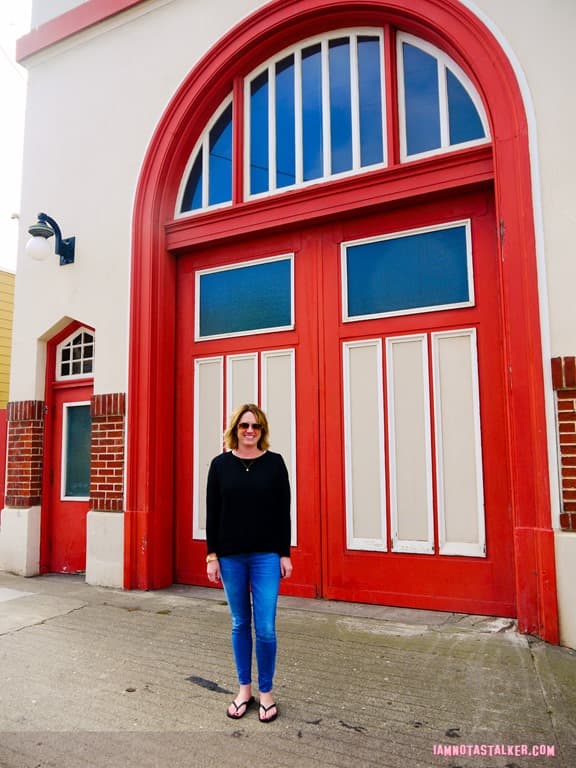
My friend Nat is a definite hostess with the mostest. When I last visited her in San Francisco in October 2016, she not only had champagne chilling in the fridge, but an itinerary of area stalking locales she thought might interest me compiled and mapped out on her phone. The spot on the list I was most excited about seeing was former Engine Company No. 43, where Mia Thermopolis (Anne Hathaway) lived with her mom, Helen (Caroline Goodall), and cat, Fat Louis, in 2001’s The Princess Diaries. This stalker loves herself any adaptive reuse and in person, the firehouse-turned-home did not disappoint. Somehow I forgot to blog about the place after returning home from my trip, though, and was not reminded of it until last Thursday when Mandy Moore, who played meanie cheerleader Lana Thomas in the film, posted a #tbt image of The Princess Diaries July 2001 premiere on Instagram. Seeing the photo brought me right back to the day I stalked the firehouse and I figured there was no time like the present to finally blog about it.
[ad]
The Mission Revival-style Engine Company No. 43 was originally built in 1911, back when firemen were still fighting blazes via horse-drawn carriages.
Following its decommission, the 4,800-square-foot wood frame structure was sold to a private buyer at a surplus auction in 1976 and subsequently transformed into a residence.
Today, the unique homestead boasts 8 rooms, 2 stories, a 340-square-foot outbuilding that initially housed Company No. 43’s kitchen, a double 0.11-acre lot, parking for 4+ cars, and original detailing throughout including a fireman’s pole.
The residence last hit the market in late 2014 with an asking price of $2.6 million (at the time it was being utilized as a 2-unit rental property) and was sold the following March for $1.85 million. That’s quite a bargain to call The Princess Diaries firehouse home, if you ask me!
Engine Company No. 43 pops up numerous times throughout the film.
In person, the place still looks much the same as it did onscreen 17 years ago.
Only the front exterior of the structure is featured in the movie.
The home’s massive side staircase also makes a couple of appearances.
Because those scenes were shot from the backyard, I was, obviously, unable to snap any photos matching the angle shown in the flick. But I was thrilled to see that the staircase is visible from the street.
The interior of Mia and Helen’s pad was nothing more than an elaborate set built inside of a soundstage a good 350 miles away at Walt Disney Studios in Burbank. You can check out some fabulous photos of it on art director Caty Maxey’s website.
Engine Company No. 43’s actual interior (which you can see here) is a far cry from its onscreen counterpart. While Mia and Helen’s home is colorful and lovingly cluttered, the firehouse’s real life inside is sophisticated and minimalist. I honestly can’t decide which I like better.
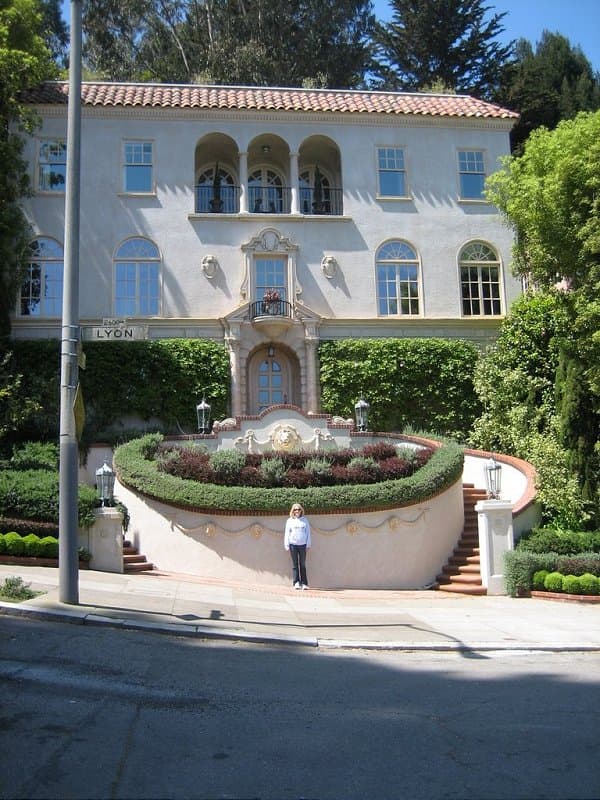
Interestingly, while The Princess Diaries was set in San Francisco, not much of the movie was shot there. Along with Engine Company No. 43, the Anthony R. Grove High School exterior (which Nat took me to stalk many moons ago) can also be found in the City by the Bay at 2601 Lyon Street in Cow Hollow. The school’s courtyard scenes were lensed a bit closer to home, though, at Alverno Heights Academy in Sierra Madre, which I blogged about here.
Big THANK YOU to my friend Nat for telling me about and taking me to this location! ![]()
For more stalking fun, follow me on Facebook, Twitter, Instagram, Los Angeles magazine and Discover Los Angeles.
Until next time, Happy Stalking! ![]()
Stalk It: Engine Company No. 43, aka The Princess Diaries firehouse, is located at 724 Brazil Avenue in San Francisco’s Excelsior District.
I have been waiting for this day for months! Yep, that’s right folks – it is finally, finally time for my annual Haunted Hollywood postings and I could not be more excited! In honor of the occasion, I have added a Haunted Hollywood category to my site and while I typically only publish three columns a week during normal months, I am going to attempt to do a write up of a new spooky spot every single day of October. God knows I have enough material! We’ll see how it goes. For my first locale this year, I thought I’d cover the house from Pacific Heights. I stalked the picturesque pad, which can’t actually be found in the tony neighborhood the film was named for but about three miles south in Potrero Hill, last fall while visiting San Francisco. Though I actually find Pacific Heights to be more anger-inducing than scary, I still thought it would be fitting to include the dwelling that served as its focal point in my October postings.
[ad]
For those who haven’t seen Pacific Heights, the 1990 thriller – or “horror film for yuppies” as Roger Ebert dubbed it – tells the story of Patty Palmer (Melanie Griffith) and Drake Goodman (Matthew Modine), a young San Francisco couple who use all their savings to purchase a dilapidated, but still rather pricey (try $749,000!) Victorian home with two rental units supposedly located at 170 Pacific Street. Patty and Drake fix up the residence themselves, move into the top floor space and lease out the two rentals, one of them to maniacal con man Carter Hayes (Michael Keaton), who proceeds to terrorize the couple, as well as the occupants of the other unit, without paying so much as a dime of his monthly rent. Due to San Francisco’s pro-tenant property laws, Drake and Patty are powerless to stop Carter, evict him, or do much of anything really. Screenwriter Daniel Pyne was inspired to pen the film’s script after his own experience of trying to evict a deadbeat tenant from an apartment he once owned.
In the film, Patty and Drake’s real estate agent informs them that the turreted home was built around 1886 and “probably remodeled slightly in the ‘40s.”
In reality, the statuesque Queen Anne was constructed in 1895.
The three-story dwelling was made to look significantly run-down for the movie’s early scenes. According to William A. Gordon in his book Shot on This Site, “When the production company discovered it, the house had been recently repainted. To create a ‘distressed’ look, they masked the entire house with sound-blasting frisket, a substance with light adhesive on one side and paper on the other. The painted side was treated with chemicals to make the exterior look cracked and aged. After two days’ filming, the crew removed the frisket.”
After Drake and Patty complete their improvements, the property comes to resemble its actual self.
Only the exterior of the residence was utilized in the filming. Interior scenes were shot on a set built on a soundstage at The Culver Studios in Culver City.
The views shown in the film are real and absolutely breathtaking (though the San Francisco skyline has changed considerably since Pacific Heights was lensed almost 30 years ago).
In fact, in Shot on This Site, Gordon says the home was chosen for the movie because of its stunning panoramic views.
Along with spectacular views, in real life the residence also boasts a corner 0.06-acre lot, 4 bedrooms, a den, 3.5 baths, 3,200 square feet, 2 fireplaces, an eat-in kitchen, bay windows, parquet flooring, vaulted ceilings, separate guest quarters, a finished basement, a 1-car garage, a patio, a BBQ area, an attic, a garden, and a studio in-law apartment, just like in the movie. Per Zillow, the pad is currently worth a whopping $3.27 million.
Zillow also states that the property appeared in several episodes of Nash Bridges, but I am unsure of which episodes in particular. If anyone happens to know, please fill me in!
For more stalking fun, follow me on Facebook, Twitter, Instagram, Los Angeles magazine and Discover Los Angeles.
Until next time, Happy Stalking! ![]()
Stalk It: Drake and Patty’s residence from Pacific Heights is located at 1243 19th Street in San Francisco’s Potrero Hill neighborhood.
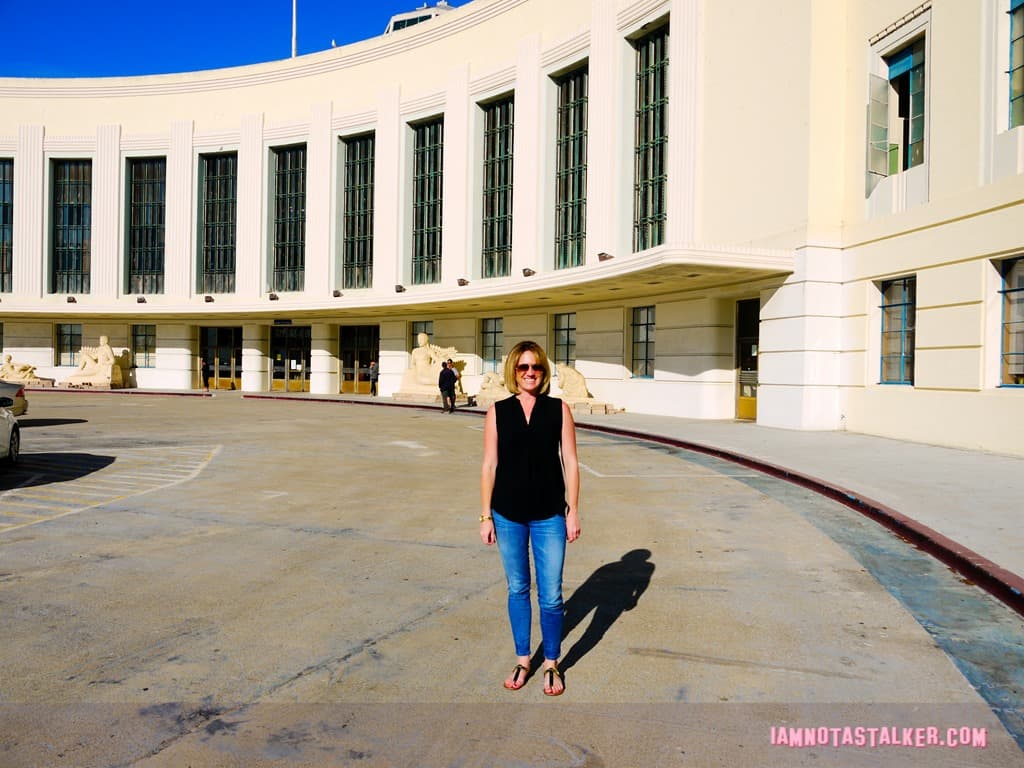
The stalking itinerary for my October 2016 trip to Northern California was extremely Scream-centric. So much so that I did not really do any research on area locales from other productions. But life threw a pleasant surprise my way shortly after I arrived in the City by the Bay. Upon landing at SFO, my mom and I headed to Treasure Island to pick up my uncle who was spending the weekend with us. As we passed through the island’s main entrance, I happened to look to my right and noticed a striking curved structure that I immediately recognized as the exterior of The Stafford Hotel from the 1998 re-make of The Parent Trap. I had long known of the building’s use in the movie and even mentioned it in this 2012 post about The Ritz-Carlton, Marina del Rey (which also masked at The Stafford in the film), but had completely overlooked it while planning my NorCal getaway and didn’t really put two and two together until I actually drove right by the place. So I, of course, had to jump out and snap some pics.
[ad]
Prior to my October trip, I had never actually visited Treasure Island, despite growing up in San Francisco – and despite the fact that my parents held their wedding reception there! (Fun fact – their reception took place at Casa de la Vista, the same spot where Patty Hearst’s wedding reception was held a few years later.) The 403-acre man-made island was created by the US Army Corps of Engineers from 1937 to 1939 on what was then the Yerba Buena Shoals. Named after the popular Robert Lewis Stephenson book, the 1-mile by 2/3-mile land mass was constructed for the 1939 Golden Gate International Exhibition, a World’s Fair that celebrated the completion of the San Francisco-Oakland Bay Bridge and the Golden Gate Bridge. It was originally intended that when the event ended, Treasure Island would be utilized as an airport. In 1938, engineer William Peyton Day and architect George William Kelham were commissioned to construct an Administration Building for the Exhibition that would later serve as the airport’s main terminal.
Utilizing Art Deco and Streamline design elements, the duo created a dramatic 148,000-square-foot, U-shaped, Art Moderne-style structure out of reinforced concrete.
Researching the history of locations is easily my favorite part of writing my blog. Sometimes though, just reading words in a book or online makes a place’s past intangible and flat. Such was the case with the Golden Gate International Exhibition. I perused articles about the fair’s exhibits and artwork, but didn’t really grasp its grandeur. Then while talking to my grandma on the phone a couple of days ago, she happened to ask what I was working on for my next post. I told her that I was writing about Treasure Island and she exclaimed, “I was there on opening day!” Yes, on February 18th, 1939, my grandma attended the inaugural day of the Golden Gate International Exhibition with her parents and sister! The fair remained in operation through October 29th, 1939 and then reopened again from May 25th to September 29th the following year. Throughout that time, my grandma visited on several occasions, with her family and also on a school trip. It was amazing to hear her stories and first-hand accounts of an event and place that I had been researching all day. She really brought the exhibition to life for me. Listening to her tales, I could practically see her walking among the towering exhibits, sampling the food, and staring in wonder at the various exotic civilizations represented in the performances and shows. The fair truly was like Disneyland! My grandma was especially fascinated by Billy Rose’s Aquacade, in which synchronized swimmers, including a young and unknown Esther Williams and Tarzan star Johnny Weissmuller, performed dazzling in-water routines. You can check out some photographs that really show the magic of the Golden Gate International Exhibition here, here, here, here, and here (in the last one, you can even see the side of the Administration Building on the extreme left).
When the Golden Gate International Exhibition closed for good in 1940, the plans to make Treasure Island an airport were put on hold due to the onslaught of World War II and the site instead became a naval base. It continued to operate as such until being decommissioned in 1997. Though the city immediately set about redeveloping Treasure Island at that time, it was not until last year (yep, last year!) that construction on the massive project actually began. Though it may take an additional 15 years to complete, more than 8.000 homes, several hotels, parkland, 240,000 square feet of commercial and retail space, a large marina, and a ferry terminal are all set to be built on the island. The Administration Building will be left intact (thankfully it’s listed on the National Register of Historic Places) and will likely be turned into a museum.
The Administration Building, Treasure Island pops up as The Stafford Hotel in a few scenes in The Parent Trap. It is there that Hallie Parker and Annie James (both played spectacularly by Lindsay Lohan) scheme to rekindle the spark between their parents, Nick Parker (Dennis Quaid) and Elizabeth James (Natasha Richardson).
Only the exterior of the building was used in the shoot. Interior Stafford Hotel scenes were filmed at the Langham Huntington, Pasadena, while the pool segments were shot at The Ritz-Carlton, Marina del Rey.
The Administration Building, Treasure Island was also featured briefly in 1989’s Indiana Jones and the Last Crusade as the Berlin airport where Indy (Harrison Ford) and his father, Professor Henry Jones (Sean Connery), caught an airship flight. As was the case with The Parent Trap, only the exterior of the property appeared in the film. Interior airport scenes were shot at Lawrence Hall in London.
For more stalking fun, follow me on Facebook, Twitter, Instagram, Los Angeles magazine and Discover Los Angeles.
Until next time, Happy Stalking! ![]()
Stalk It: The Administration Building, Treasure Island, aka the exterior of The Stafford Hotel from The Parent Trap, is located at 1 Avenue of the Palms in San Francisco.
Well, my fellow stalkers, I am finally home from my trip back east. Over the course of twelve days, the Grim Cheaper and I hit up Washington D.C., Baltimore and Philadelphia and stalked a myriad of locations in the process (I took close to 3,000 pictures! I’m shocked my computer didn’t crash when I uploaded them all!). Those posts will be coming soon. In the meantime, though, we had to scoot off on another quick trip (I swear I think I have traveled more this year than any year prior), so my friend, fellow stalker Michael, of countless The Brady Bunch posts fame (you can read them here, here, here and here) has graciously stepped in yet again with a slew of fabulous guest columns that I will be publishing over the course of this week. Thank you, Michael! So without further ado . . .
[ad]
I’m back for my fifth guest post. And brace yourself, it’s not about The Brady Bunch—what ever happened to predictability? I’ve flipped the calendar from the 70s to 2016 to cover a contemporary comedy, Fuller House, created and produced by the same folks that brought us Full House and starring most of the cast from the 90s classic.
I had anxiously awaited the release of the new series since it was first announced, even visiting Warner Bros. last winter (and again this summer, but that’s a story for another day) to get a better look at a backlot facade they’d built to stand in for the San Francisco-located home used on the original sitcom. I was looking forward to seeing how they’d incorporate the new facade into the program and how they’d redo the iconic opening titles.
Although I was pleased enough with the new show, I’ll admit I was a little disappointed that Fuller House didn’t go all out and create a multi-location opening title a la Full House, and instead went with a more modern opening without any on-site filming. The tenth episode, “A Giant Leap,” was filmed partly on location at AT&T Park in San Francisco, but even those scenes were limited to the ball park. The new series didn’t offer many new establishing shots to track down, and even the facade that had been built on the Warner Bros. backlot went mysteriously unused, while vintage footage of the San Francisco home was dusted off to establish scenes set in the iconic house.
Something new did catch my eye, though—an establishing shot used throughout the first season. D.J. Tanner—not to be confused with her sister Stephanie who’s now a D.J. spinning under the name D.J. Tanner—is a veterinarian working at Harmon Pet Care. And while all of the interior scenes were shot at Warner Bros. in Burbank, the establishing shot of the clinic was filmed in San Francisco’s Chinatown. Admittedly, it wasn’t much work to pin down this location. Paper lanterns, ornamental street lights, and a sign that reads “Welcome to Chinatown” left little doubt.
On my last visit to San Francisco, I headed to the Dragon’s Gate—the formal entrance to Chinatown, and the beginning of a major shopping artery. The Dragon’s Gate actually appeared in the unaired original pilot episode of Full House. Rather than send the cast to Northern California, production had body doubles for the actors filmed at quintessential San Francisco landmarks. These clips were then used extensively in the closing titles of the pilot, and some also reappeared in the first season opening and closing titles.
Continuing my walk, I quickly came upon the intersection shown in Fuller House—Grant Avenue and Sacramento Street, looking south.
As I started to line up the shot, I noticed something that I hadn’t at home. The Harmon Pet Care sign is mounted to an entirely different building than the building with the Harmon Pet Care awning. Because of the angle of the shot used on Fuller House, you can’t see much of the facade behind the sign. I imagined that the pet clinic signs were digitally added to to a piece of stock footage in post-production. My suspicions about the digital manipulation were confirmed when I noticed that among other changes, an awning at the end of the street in the clip is brown in the Fuller House clip, but is currently red, and has been for at least a couple of years before the production of the new show.
The Harmon Pet Care sign is superimposed over Old Shanghai, a home decor and fashion retailer.
And the awning is that of the Far East Café.
I didn’t dine at the Far East Café, so I can’t attest to their menu offerings, however I’ve read that it’s a particularly vintage restaurant and has some unique architecture. The building dates back to the early 1900s, while the restaurant opened in the 20s and some of the original decoration is even older having been imported from China.
The rest of the block and signage looks very similar to the Fuller House establishing shot.
The eighth episode, “Secrets, Lies and Firetrucks,” contains the only evening establishing shot of the pet clinic. For this footage, the camera was moved to the opposite end of the block.
It wasn’t until I was writing this post that I noticed an entirely different building was shown in an establishing shot for the season’s last episode, “Love Is in the Air.” Nearly all of the business names were digitally removed, but thankfully they left a visible address that allowed me to home in on the alternate location. For this clip, B & C Laundromat on Waverly Place stands in for Harmon Pet Care. The awning from the Far East Café footage was digitally reversed and placed above its entrance.
Editor’s Note – A big THANK YOU to Michael for sharing this fabulous post with us (especially the uh-ma-zing graphic below, which I’m enthralled with)! I’m already looking forward to the rest of this week’s offerings! ![]()
Stalk Them: Far East Café and Old Shanghai, aka Harmon Pet Care from Fuller House, are located at 631 and 645 Grant Avenue in San Francisco, respectively. B&C Laundromat, aka Harmon Pet Care from the “Love Is in the Air” episode, is located at 115 Waverly Place in San Francisco.